The Trust Deficit of 2026
and Why Small Businesses Feel it First
Something feels off.
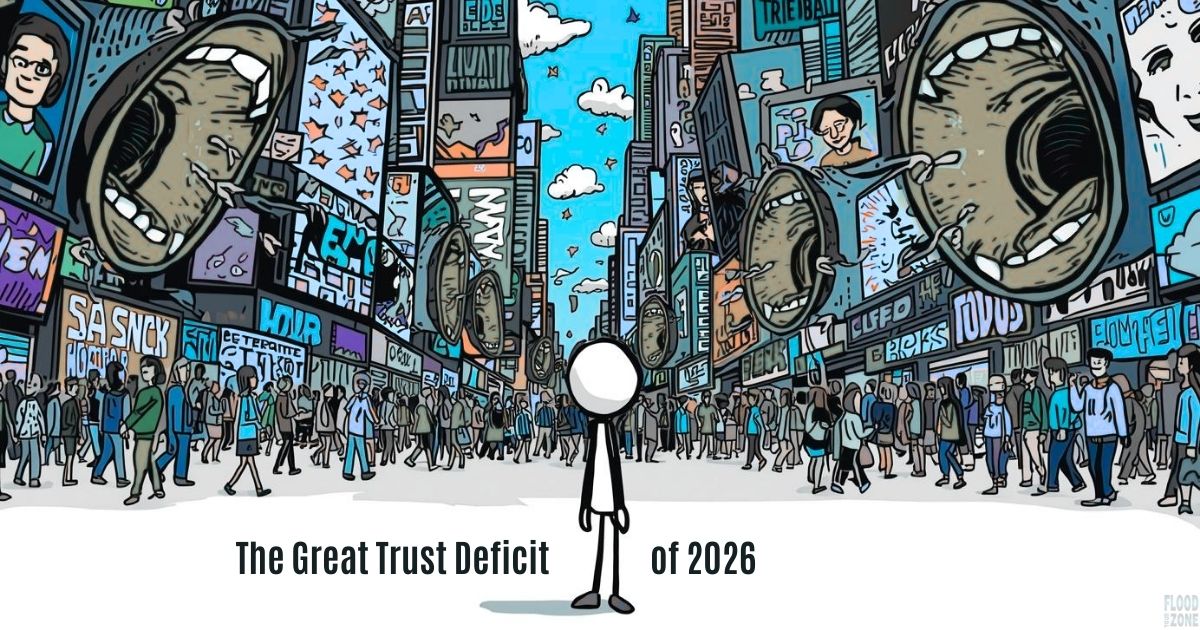
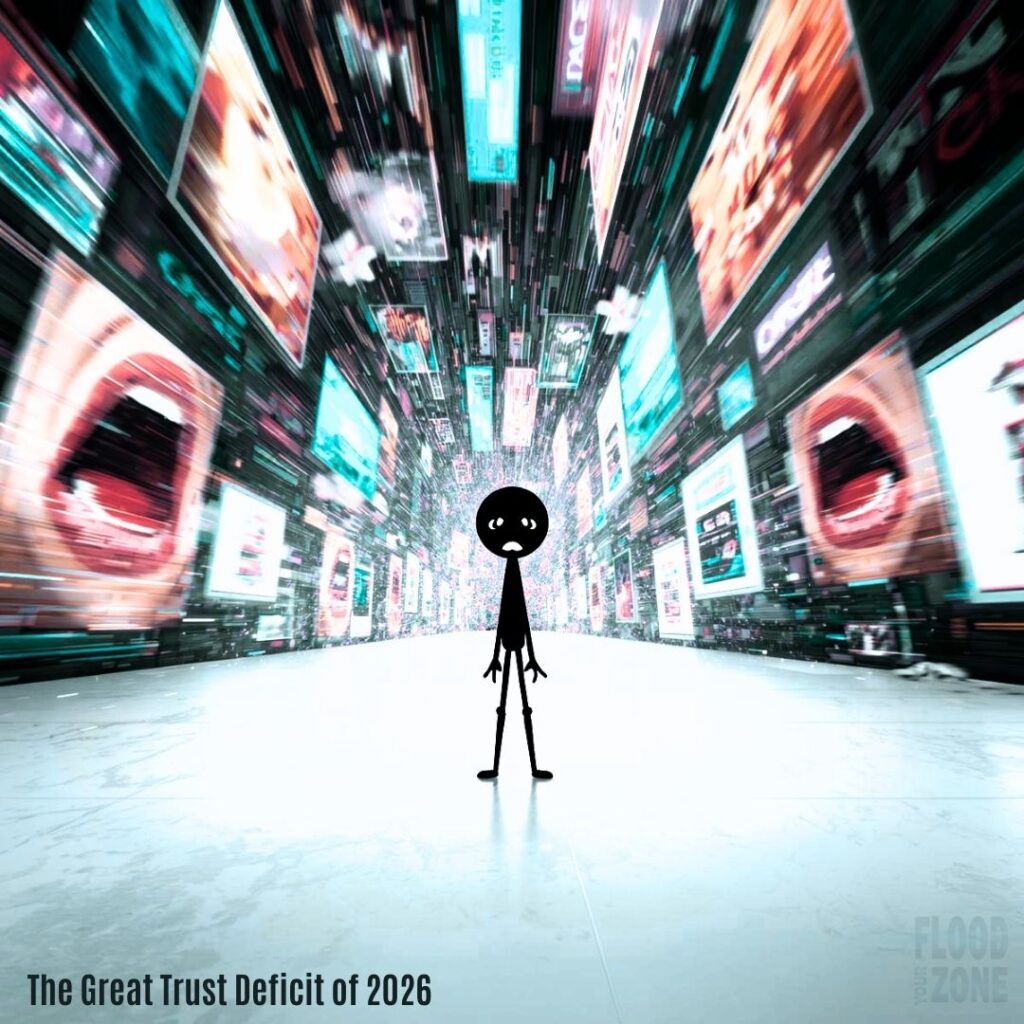
Marketing is louder than ever… more ads, more emails, more content, more promises. Yet trusting what we see, hear, and read is becoming harder than ever.
We’re drowning in information, bombarded from every direction, all day long. From the moment we wake up to the minute we fall asleep, it’s a nonstop flood of marketing and information.
But instead of feeling informed, most of us feel guarded. Skeptical. Like everything needs to be questioned, verified, double-checked.
Businesses are saying more, but people are hesitating. Even companies doing everything “right” are noticing that the attention they work so hard to earn doesn’t convert the way it once did.
And for solopreneurs and small businesses, as we head into what increasingly feels like “The Great Trust Deficit in 2026”, a strong and strategic shift in our approach to marketing is going to be crucial.

The Quiet Erosion of Trust
Trust didn’t disappear overnight. It’s been eroding quietly for years, but now it’s got a choke-hold.
Consumers today are navigating an environment filled with:
- Spam and scam emails that look legitimate
- AI-generated content that’s harder than ever to identify as AI
- Impersonation, phishing, and fraud at record levels
- Endless “limited time” offers that never actually end
- Polished messaging that says everything (and nothing at all)
The result isn’t outrage. It’s skepticism.
People aren’t necessarily angry, but they are definitely cautious.
They read more carefully. They click less often. They hesitate before believing what they’re told.
Everyone is assuming there’s a catch… because too often, there is.
And this skepticism isn’t limited to marketing. It has bled into how we feel about institutions, systems, authority, and our fellow humans.
We’ve now hit a point where nothing is immune to this skepticism and distrust.
We now feel the need to question whether online reviews are real, whether ads mean what they say, should we click on that link or trust that QR code.
The point isn’t whether any single suspicion is valid. It’s that skepticism has become our default posture.
And it’s directly affecting business.
Why Small Businesses Feel This First
Large corporations can absorb distrust. Small businesses can’t.
Big brands have name recognition, familiarity built over decades, and the benefit of perceived legitimacy. Even when trust wavers, people assume a certain baseline of stability.
Solopreneurs and small businesses operate differently. Every interaction carries more weight. Every inconsistency is more noticeable. Every vague message or mismatched signal creates automatic skepticism.
When trust is low, people don’t experiment or take chances… they retreat to what feels familiar.
That’s why small businesses feel this shift first:
- Fewer second chances
- Less margin for confusion
- Greater reliance on clarity, coherence, and consistency
A Pattern Even Big Companies Are Responding To
What’s interesting is that this isn’t just a small business problem.
Many large, employee-driven companies have quietly adjusted their approach in response to the same cultural shift. Instead of relying solely on polished brand campaigns, they’re leaning into their employees, human presence and expertise.
Not because personal branding is trendy.
Not because everyone needs to become an influencer.
But because people trust people more than they trust institutions.
At scale, corporations are rediscovering something small businesses have always known: trust is built through familiarity, consistency, and human connection… no longer through bombarding us with constant marketing and information.
What large organizations are trying to re-introduce intentionally, solopreneurs already possess by default.
The difference is whether that advantage is used intentionally or accidentally.
Where Marketing Starts to Break Down
Here’s the uncomfortable truth most marketing advice avoids:
Marketing tactics don’t fail because they’re bad.
They fail because there’s nothing underneath them, no foundation.
- Email doesn’t stop working just because inboxes are crowded.
- Social media doesn’t stop working just because algorithms change.
- Content doesn’t stop working just because attention spans are shorter.
These tools stop working when trust hasn’t been established first.
Tactics are amplifiers. They magnify whatever foundation already exists. When trust is strong, tactics accelerate growth. When trust is weak, tactics accelerate skepticism.
That’s why marketing feels harder right now. The tools aren’t broken, the environment has changed.
Branding Is Not Decoration, It’s Trust Infrastructure
This is where branding is often misunderstood.
Branding isn’t logos, color palettes, or clever taglines (at least not primarily).
Those are expressions, not the core.
At its foundation, branding is about:
- Consistency
- Recognition
- Coherence
- Predictability
- Signals people can rely on
Branding answers quiet but important questions:
- Who are you?
- What do you stand for?
- What should I expect from you?
- Why should I trust you to deliver what you promise?
In a high-trust environment, branding can feel optional.
In a low-trust environment, it strong brand-building becomes essential.
Branding is how trust forms before an action is ever taken.
Why Solopreneurs Are Uniquely Positioned Right Now
This is the part that often gets missed.
Solopreneurs don’t need to manufacture human presence in the same way big companies are now scrambling to!
Solopreneurs and small business don’t need to simulate authenticity like big companies because they are real humans!
And they don’t need to pile on layers of bombarding messaging and information to gain attention and earn trust like big companies have to spend millions of dollars to do!
Solopreneurs and small business are the humans that people (consumers) want to interact with, support, buy from and hire!
The challenge is no longer becoming visible.
In this trust deficit, the challenge is becoming intentionally consistent.
Consistency and having a clear, strong brand earns trust.
The majority of solopreneurs make these mistakes:
- Change messaging frequently
- Chase new tactics every month
- Sound different across platforms
- Undermine trust without realizing it
This is a result of not building a strong foundation.
Build your brand to act as your foundation.
Without a strong brand, marketing has nothing to stick to, and skepticism becomes the default response it creates.
What This Means Going Forward
None of this means tactics don’t matter.
Email still matters.
Content still matters.
Visibility still matters.
Engagement and good customer service still matters.
But how those tactics are used (and what they’re built on) matters more than ever.
In 2026, the businesses that stand out won’t be the loudest.
They’ll be the clearest.
The steadiest.
The most recognizable, not just for their visuals, but for what they consistently signal.
In a world where trust feels scarce, consistency becomes a differentiator.
And that consistency comes from building a strong, strategic brand.
Brand-Building for Solopreneurs - 2026